EduNews Logo
  • Home
  • Resources
  • e-Learning
  • Contact Us
  • Blog

World-class experiences

The rich experiences of others from around the world

Ash Grove Primary School leaps up the league tables

Ash Grove Primary School - MacclesfieldAsh Grove second most improved in the country and most improved in North!


Figures recently published by The Department of Education in the UK show that Ash Grove Primary School in Macclesfield is the second most improved school in the country and is the most improved school in Cheshire and the North of England.


When comparing the percentage of Year 6 pupils attaining the expected level in English and Maths in 2009 with the results achieved in 2011, Ash Grove improved by a massive 77 percentage points.  The school has shot into the top 50 schools out of 122 primaries in Cheshire East and it is now amongst the best performing schools in Macclesfield.


Head of Governors Sue Bowen is delighted with the results:


“This is incredible news. In 2008 the school hit rock bottom and was given a 3 year timescale in which to make major changes to avoid closure.  For the sake of children and families on the Moss estate we began the fight to keep the school open. The achievements of the teaching team are quite remarkable. However, whilst these results are grabbing the headlines, the school is about much more than that…the whole culture has changed, Ash Grove is now a happy place, where children learn effectively and develop in every aspect.”


Head Teacher, Kevin Simpson, who joined the school in September 2009 commented:


“This has been an amazing time in the school’s 75 year history and facilitating the many changes necessary has only been possible with the unstinting dedication of staff and the governors.  We now have a school that we, the children and their families are immensely proud of.”


Asgrove Primary School Website


International School Award to Banbury School

World Challenge students from Banbury Sixth Form meet school pupils in Tanzania.International School Award recognises impressive range of work by Banbury School


Banbury School in Oxfordshire, UK has been successful in retaining the International School Award. Banbury School is now accredited for the next three years.


The ISA said “Congratulations on working so hard to co-ordinate such an impressive range of International work. You are a credit to your local and wider community.”


To win this award the school organised trips from Paris to Kenya, educational visits to Tudor Hall for foreign theatre work and held visits for students from all over the world as well as being very committed to participating in World Challenge.


We were also involved in the Comenius project which included visits to Hennef in Germany last November and Madrid this March. This helped enormously to establish and strengthen further international links and learn about key environmental issues that affect each country involved in the project (England, Germany, Norway and Spain).


Dr Fiona Hammans said “We are very of proud of this award. It is really important that our students learn and share the diversity of cultures and language across different countries. Well done to all the staff and students who have taken part and helped to win this award.”

 
Find out more on the International School Award website.

Penrith Christian School - NSW Australia


Penrith Christian School is an Independent Christian Preparatory to Year 12 School, offering parents the option of one decision, one school. "We are a Ministry of ImagineNations Church and have an enviable reputation for achieving excellence in a wide range of curriculum areas, including academia, sport, and the creative arts".
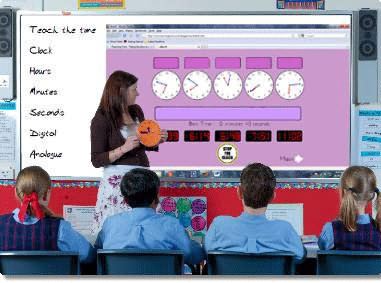


EA014 Speakers in Penrith Christian SchoolYear 4 sat there eagerly awaiting their turn to answer the comprehension puzzle on their new Interactive Whiteboard. The enthusiasm on their faces and their eagerness to participate in the lesson was amazing to watch, the children were literally jumping out of their seats to have a go.

“It has only been installed for a couple of months, but the kids love it” says Kylie Hutchinson, year 4 teacher at Penrith Christian School.

Up to the board they ran and arranged the words back in to the sentences like it was second nature. More importantly, they were enjoying the learning process and were actively encouraging and supporting one another right throughout the lesson.

Mid lesson saw the students play an online game called ‘Stop the Clock.’ This was a great break from comprehension, it kept the students enthused as they each came up in pairs to try and get the best time at organizing the digital vs. analogue clocks (see the picture). www.teachingtime.co.uk

Finally it was on to spelling. Mrs Hutchinson quickly drew some impromptu scenarios on the interactive board and then had the students suggest the best word to describe the scenario. The person who got it correct then had an opportunity to write the word on the board and explain to the class the meaning of the word.

“I constantly look for interactive activities to integrate into the curriculum.” Said Mrs Hutchinson. “I don’t use it in every lesson, but because they love it so much, I love using it.”

The students retired at the end of the lesson for lunch, eager to go and play - not that it appeared all too differently during the lesson.

It is easy to see, putting the technology in the right hands certainly has the students truly involved in the lesson and loving the learning!

Some of the Resources used during the lesson:
Springboard to Comprehension: www.macmillan.com.au
Beat the Clock: www.teachingtime.co.uk

About the School:

Penrith Christian School is an Independent Christian Preparatory to Year 12 School, located in a semi secluded relaxed setting just outside of Penrith near the M4 Freeway in Orchard Hills, New South Wales, Australia. Set on 12.5 Hectares, the state of the art school offers a wide range of curriculum areas, including academia, sport, and the creative arts. www.pcs.nsw.edu.au

The Interactive classroom equipment was provided by TwoTouch Ltd with TwoTouch interactive whiteboads and Edis audio systems


Moving beyond 'blame the teacher'

The problem with schools isn't teachers; it's a management system that pushes them aside. The documentary "Waiting for "Superman" questioned the USA's public education system. (Courtesy of Paramount Pictures)
   
Most of the current efforts to improve public education begin with the flawed assumption that the basic problem is teacher performance. This "blame the teacher" attitude has led to an emphasis on standardized tests, narrow teacher evaluation criteria, merit pay, erosion of tenure, privatization, vouchers and charter schools. The primary goal of these measures has been greater teacher accountability — as if the weaknesses of public education were due to an invasion of our classrooms by uncaring and incompetent teachers. That is the premise of the documentary, "Waiting for Superman," and of the attacks on teachers and their unions by politicians across the country.
 
 
We see distressing parallels between this approach to quality in education and the approaches that failed so badly in U.S. manufacturing. Recall the reaction of domestic manufacturers in the 1970s as Japanese competitors began to take market share: Many managers and an army of experts blamed American workers. They denounced workers' "blue-collar blues," lackadaisical attitudes and union job protections as the chief impediments to higher quality, productivity and competitiveness.
 
 
It took nearly two decades for manufacturers to realize that this diagnosis was deeply flawed and that the recommendations that flowed from it were leading U.S. industry further into decline. Recall the success of Japanese-run auto transplants operating in this country during the 1980s: They reached world-class quality levels with a U.S. workforce, in some cases a unionized workforce, while domestic auto companies continued to blame American workers and saw their quality levels stagnate.
  
 
Noticing the discrepancy, a growing number of manufacturers turned to the teachings of the quality guru W. Edwards Deming. Deming argued that U.S. industry's failure was not in its workers but in the system they labored under. He taught that pushing workers to work harder in a poorly designed system cannot improve outcomes. U.S. firms were being outcompeted because they relied on an outdated management system in which decisions were all top-down, tasks were narrowly specialized and workers were told to leave their brains at the factory door. To fix quality, manufacturers needed to fix these systems, and to do that, they needed to involve workers in that effort. Do those two things, and American workers were willing and able to achieve world-class levels of performance.
 
 
Much of the current wave of school reform is informed by the same management myths that almost destroyed U.S. manufacturing. Instead of seeing teachers as key contributors to system improvement efforts, reformers are focused on making teachers more replaceable. Instead of involving teachers and their unions in collaborative reform, they are being pushed aside as impediments to top-down decision-making. Instead of bringing teachers together to help each other become more effective professionals, district administrators are resorting to simplistic quantified individual performance measures. In reality, schools are collaborative, not individual, enterprises, so teaching quality and school performance depend above all on whether the institutional systems support teachers' efforts.
 
 
There are, thankfully, some examples of education reform that have moved beyond the blame-the-teacher view. A 2010 study by researchers at Rutgers University unpacked the lessons of six cases — from across the country, urban and rural, large and small — in which teachers, unions and administrators have worked together in their school districts to improve student performance. One case, the ABC Unified School District, about 25 miles southeast of Los Angeles, created a partnership between the administration and the ABC Federation of Teachers that goes back more than 10 years.
 
 
In this partnership, teachers, union representatives and administrators have developed rigorous peer assistance, mentoring and evaluation systems that have raised the level of teaching quality. They have worked together on recruiting, compensation and retaining high-quality teachers and administrators. The district has collaborated with teachers on planning, curriculum design and improving instructional practices. They have brought teachers together in teams to integrate student learning across disciplines and evaluate student progress. They have expanded opportunities for parent involvement.
 
 
Performance results have been outstanding. Although 25% of students are English-language learners and about 46% get free or reduced-price lunches, over the last decade the district has performed well above the state average on California's Academic Performance Index, with strong growth in these scores of about 10% per year. The district's graduation rate is 89.1%, while the statewide rate is 74.4%.
 
 
Another example is the Plattsburgh City School District in upstate New York, where the Plattsburgh Teachers' Assn. participates in, and sometimes leads, committees that oversee textbook selection, professional development, teacher evaluation, mentoring and peer coaching, curriculum development, long-range planning for the use of information technology and analysis of student test scores and performance. Since 1977, the union has been an integral part of the search and hiring process of teachers and administrators, including the superintendent. Here, 52% of students receive free or reduced-price lunches, yet student performance exceeds the averages for proficiency across the state in language arts, math and science. The Plattsburgh high school graduation rate improved from 72% in 2004 to 88% last year; the statewide average was 73.4%.
 
 
These cases and many others like them were highlighted in February at the U.S. Department of Education's conference on "Advancing Student Achievement Through Labor-Management Collaboration," and in October at the "National Conference on Collaborative School Reform," organized by the American Federation of Teachers working with Rutgers University, Cornell University and MIT. These districts offer proven models consistent with the best practices of U.S. industry.
 
 
As school begins, we would do well to remember Deming's lesson: In education as in industry, progress toward quality will require collaboration among administrators, teachers and their unions.
 
 
Saul Rubinstein and Charles Heckscher are professors at  and co-directors of the Center for Organizational Learning and Transformation; Paul Adler is a professor at the Marshall School of Business at USC. The Rutgers study referred to is available at http://smlr.rutgers.edu/collaborating-school-reform.


BETT 2012 - Exhibition Alert


We hope to see you at the BETT show - Olympia London between 11th to 14th January 2012. The BETT organisers say "at times when technology has a vital role to play in modern teaching and learning, a visit to BETT (Enter the priority code EM11) can help you make sense of the latest education technology and resources available".

  1. Litherland High School - AV Awards Finalist Project
  2. A New Kind of Distance Learning
  3. 793 million illiterate adults around the world
  4. Amplified Classrooms - in the USA

Page 3 of 4

  • 1
  • 2
  • 3
  • 4
Quick Links
  • Ed-Cast
  • Edis Audio Visual News
  • Edis Audio Visual
Follow Us
Subscribe Newsletter

subscribe to Edis Education Learning Community here

Keep up to date with news, events, articles, comments, new products etc.

© 2026 Edis Education. All Rights Reserved.