Articles - Latest and archive
Articles to inform, alert and inspire
The size and shape of a classroom affects the loudness and intelligibility of speech depending on the distance between teacher and pupils.
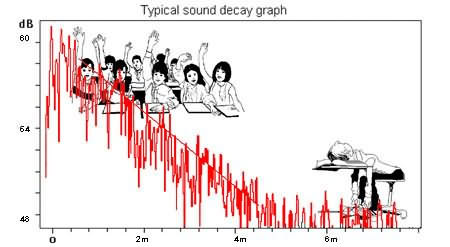 At a distance of 1 metre, the sound level of normal speech is about 60 dB. However, each doubling of the distance reduces the sound level by 6 dB. For a pupil sitting 2 metres away from the sound source, the signal is 54 dB and at 4 metres, the signal is only 48 dB.
Typical background sound levels in a classroom are about 60 db, so a teacher needs to raise their voice level above this by about 15 dB. A suitable sound pressure level is about 75 dB to be heard distinctly, this level maybe difficult for many teachers to maintain all day. If a teacher remains at the front of the class, sound levels at the back could easily be lost in the background noise by the end of the day.
A microphone, amplifier and multiple speakers can boost the sound level and distribute it more uniformly in the classroom especially if ceiling speakers are used or speakers mounted on the side walls.
Class discussions may also benefit from additional microphones (or passing a microphone from pupil to pupil) so that everyone can hear and contribute.
An amplifier system needs to be designed especially for classroom use as the construction and size of a classroom is very different to the rooms in normal houses
Voice amplification is only a partial solution if the building design is poor for sound. The amplified sound may well interfere with teaching in adjacent classrooms if interior walls do not perform well as an acoustic barrier.
About the Author
David Edis-Bates, C.Eng MIET spent more than 30 years in export related communication, IT and electronics activities around the world. He lived in Taiwan for 4 years in the late 70’s and in China since 2004. He taught part time in further education for several years in the UK and is currently CEO of EdisAV doing more of what he enjoys doing most.
Sound reinforcement systems in the classroom can significantly improve pupils academic performance.
 Pupils can spend as much as 40% to 50% of their school day involved in listening to their teacher. However, as studies have indicated (Journal of the American Medical Association) 14.9% of children aged from 6 to19 years may suffer some form of hearing loss. Similar studies have also showed that around 80% of pupils may have some form of occasional hearing loss during their time at school.
In a recommendation published by the UK Department of Education & Skills (DfES) “Building Bulletin '93” it states that ‘All children benefit from improved speech clarity, not only those with permanent or temporary hearing loss. Academic performance has been shown to improve for all class members with improvements noted in task behaviour, attentiveness,understanding of instructions, less repetition required, better attendance and improved levels of verbal recognition.
‘Furthermore, due to the clarity of speech from the teacher, similar improvements in learning performance are also noted in students for whom English is a second language.’
More recently Government legislation in the USA, UK and Europe requires that new schools in particular need to comply with a minimum standards of acoustic performance in classrooms. Effective levels of speech recognition for pupils is considered paramount and the use of sound reinforcement systems is also viewed as a viable solution.
A typical sound reinforcement system provides the teacher with a wireless or infrared microphone (more usually a lapel or pendant type) which links to an amplifier and loudspeaker system.
Sound reinforcement systems raise the level of the teacher's voice but are intended to be non-intrusive. These systems have been in use quite extensively in the USA over the past 15 years or so and are seen as a significant opportunity to improve academic performance in the UK and in Europe.
In line with the UK DfES equipment recommendations, systems have been developed to meet the needs of the classroom. With a choice of microphones with either radio frequency or infrared wireless transmitters, there are a variety of solutions available providing a range of benefits.
Infrared transmitters are becoming more popular as they limit the signal to the confines of one classroom, enabling many systems to be used in a single school without suffering the interference problems associated with RF wireless systems. Systems may have integrated receivers and amplifiers or for more cost effective solutions have separate receivers that can be connected to existing classroom sound systems associated with interactive whiteboards. Speakers should be placed to provide an effective sound pressure level throughout the classroom for best effect and may be ceiling or wall mounted.
Useful links
EA1133 Infra red microphone for the classroom
Teacher who lost voice trying to make herself heard awarded £150,000
Hillingdon council in United Kingdom agrees out-of-court settlement with Joyce Walters over damage to vocal chords caused by playtime noise
A teacher of English whose voice was permanently damaged as she struggled to make herself heard in the classroom has been awarded more than £150,000 in compensation.
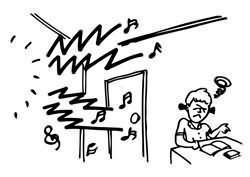 Joyce Walters had to give up teaching after developing nodules on her vocal chords, which she blamed on the noise outside Harlington adult education centre in Hillingdon, north-west London. She says she can still only speak for a short period before her throat becomes sore and her voice hoarse, despite months of speech therapy.
The 50-year-old, who has received the six-figure sum – thought to be one of the biggest payouts received by a teacher – through two out-of-court settlements agreed by Hillingdon council, started to teach English to foreign students at the centre in 2005. She was given a classroom next to a courtyard used by schoolchildren during playtimes, and says she often had to repeat herself and raise her voice to be heard over the noise and disruption.
Within a month, she claims, she had a sore throat, which got progressively worse. Her problems were compounded by the fact that, because many of her students were beginners, clear pronunciation was vital.
The vocal chord nodules were discovered through exploratory surgery. She claims she repeatedly asked for help from her bosses at the centre but nothing was done.
After taking the council to a disability discrimination employment tribunal, she was awarded an out-of-court settlement of £11,000; a second settlement, of £145,000, was agreed in July following a separate personal injury claim.
"Teaching was my calling. I adored the classroom and miss it so much, but the problems with my voice make it impossible for me to ever go back," Walters said.
"I even have to think twice about day-to-day things, like speaking on the phone to my dad in Scotland, as my voice is not strong enough to maintain a conversation for any length of time."
Joanne Jefferies, an expert in workplace injuries at the law firm Irwin Mitchell, which represented Walters, said: "Despite numerous attempts to raise her concerns with her employer, Mrs Walters was ignored and it has resulted in this terrible, life-altering injury, for which she is owed a big apology … What makes this case so sad is that this could and should have been avoided.
"It is now imperative that lessons are not only learned but shared with other schools throughout the country to ensure that further suffering is prevented."
Jean Palmer, the council's director of planning, environment and community services, said: "After a period of almost three years, the council felt that it was in the best interests of Mrs Walters, the council and taxpayers to settle the claims.
"Mrs Walters had brought employment claims and separate personal injury claims against the council, and had agreed to settle her employment claims last year without any admission of liability on the part of the council.
"The more recent settlement was made out of court and brings to a close the claims made by Joyce Walters.
Read more ...
Amplified Classrooms Barbara Pytel Saturday, 28 June 2008